Rooftop Heat Proofing for Landed Homes in Singapore: Insulation, Screed and Reflective Coating
The top floor of a landed home is usually the hottest room in the house, because the roof takes the full afternoon sun. Before you spend money on it, it helps to know what each fix does, what the evidence actually shows, and which checks come first.
What does heat proofing a landed roof involve?
- Reflect more sunlight. A light, high-reflectance coating bounces more sun away than a dark or weathered surface.
- Slow the heat down. Insulation reduces how much of the heat that reaches the roof gets through to the ceiling below.
- Shade the roof. Covers or planting keep sun off the surface, but they can raise approval questions.
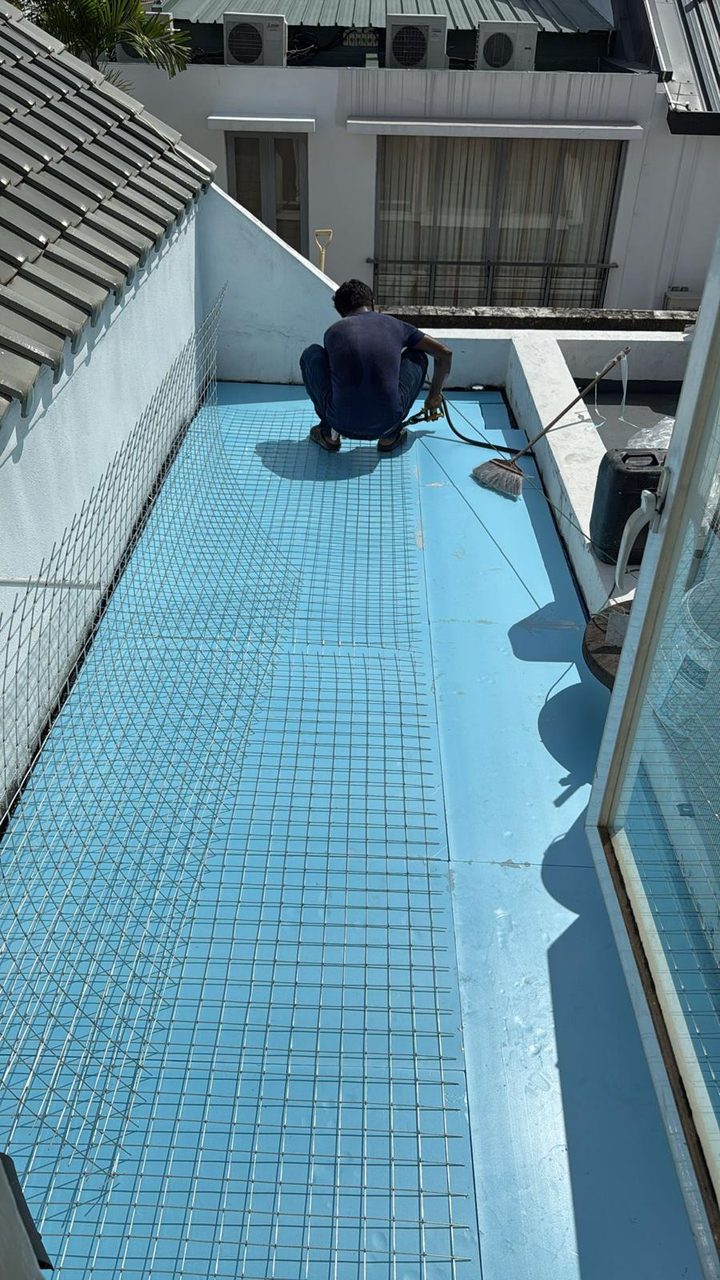
On our rooftop jobs we build the roof up in layers rather than relying on a coating alone. We lay an insulation layer first, cover it with a cement screed, and then apply a heat reflective coating on top. The photo shows the blue insulation layer on one of our landed home roofs before the screed and coating went on.
Does a heat reflective coating work in Singapore?
The study coated the roofs, walls and pavement of one street canyon in western Singapore and compared it with an uncoated one, with NTU describing two months of monitoring. It was a street-scale study in an industrial area, not a measured landed house, so it does not give an indoor figure for your top floor.
A separate 2015 model, validated against two Singapore apartments, predicted up to 2.4 degrees Celsius lower indoor air temperature on a sunny day for a naturally ventilated concrete roof with a coating of solar reflectance 0.74. That is a prediction for one configuration, not a measurement of your home. So treat any promised "drops X degrees" with caution, and ask how it was measured and on what kind of roof. We do not quote a temperature drop for our own jobs.
Why do heat reflective coating results fade?
We did not find tropical field data on how algae and heavy rain change this, so the right questions are practical ones: how is the roof cleaned and how often, when is a recoat usually needed, and what does the warranty cover and what voids it?
Do insulation and a cement screed change what the roof has to carry?
| Option | What it adds | What to check first |
|---|---|---|
| Reflective coating only | A thin surface layer that reflects more sunlight | Surface condition, existing waterproofing, cleaning and recoat plan |
| Insulation, screed and coating | Insulation plus a screed layer, so more weight and thickness | Roof loading, finished level, drainage falls, where the waterproofing sits, approval position |
| Covers, shade or planting | Structures or soil on the roof | Planning controls, structural safety, loading and exemptions |
Should the roof be waterproofed first?
Our guide to roof repair and waterproofing explains how to trace a leak and what a waterproofing scope should include. Also ask the contractor to show where the waterproofing layer sits in relation to the insulation and screed.
Do roof heat proofing works need approval?
- Terrace houses and URA rules. URA's guidance for terrace houses says a roof less than 3 metres below the top of the permissible building envelope must be a reinforced concrete flat roof, non-accessible except for maintenance. Roof terraces may be proposed on the attic floor, at least 3 metres below the top of the envelope, with a 1.0 metre parapet and a 1.8 metre party wall on shared boundaries. A pavilion, canopy or trellis may be allowed over a roof terrace if it sits within the envelope. Semi-detached houses and bungalows have their own pages, so check the one for your type.
- Structure, profile or loading. Anything that changes the roof structure, profile or loading can bring structural approval, so do not assume.
- Work at height. Roof work has its own safety rules under Singapore's Workplace Safety and Health regulations, including fall protection and fragile surfaces. Ask who provides safe roof access.
- Fire performance and compatibility. Ask for written confirmation that the materials are compatible with your existing roof and waterproofing, what fire performance applies to your roof type, and whether the work affects any existing warranty.
- Covers, shades and raised layers. These need a scope-specific check of planning controls and structural safety. Our guide to landed property reinstatement covers how to check what was approved.
What should I ask a rooftop heat proofing contractor?
- Will you survey the roof, including leaks, cracks, drainage and existing coatings, before quoting?
- What is the product's solar reflectance, and under which test method?
- What is the layer order, and how does the waterproofing sit with the insulation and screed?
- What are the cleaning and recoat expectations, and what does the warranty cover?
- Who confirms whether approval is needed, and in writing?
- How will we measure the result? Agree a method before work: surface temperature and a top-floor indoor temperature log, before and after, in comparable weather, with sensor positions and air-conditioning settings recorded. Do not treat a lower surface temperature as an equal indoor drop or an electricity saving.
Frequently asked questions
Will rooftop heat proofing cut my aircon bill?
How long does rooftop heat proofing last?
Does a reflective coating replace insulation or shade?
Do I need approval to heat proof a landed home roof?
Thinking of heat proofing your landed home roof?
Send us your roof type, rough area and whether it has leaked. We will tell you what we would check first, including loading, waterproofing and approvals, before anything is quoted.
WhatsApp us for advice →- NTU: cool paint coatings field study release
- 2024 street-scale cool coating paper
- Zingre et al. 2015: cool roof heat transfer model validated in Singapore
- De Masi et al. 2025: three-year ageing campaign of cool coatings
- URA: terrace houses, roof
- Singapore Statutes Online: work at height regulations
Authoritative sources for further reading. This guide is general information, not engineering or legal advice. Confirm approvals and loading with a Qualified Person before work starts.